Newsletter Subscribe
Enter your email address below and subscribe to our newsletter

On April 9th, team technical chiefs, engine manufacturer representatives, and senior figures from the FIA and Formula 1 will sit down with a single objective: agree on the changes needed so that the Miami Grand Prix on May 3rd no longer resembles what the world watched in Australia, China, and Japan. The Race has confirmed that six concrete solutions are on the table — and that three specific problems are driving the agenda.
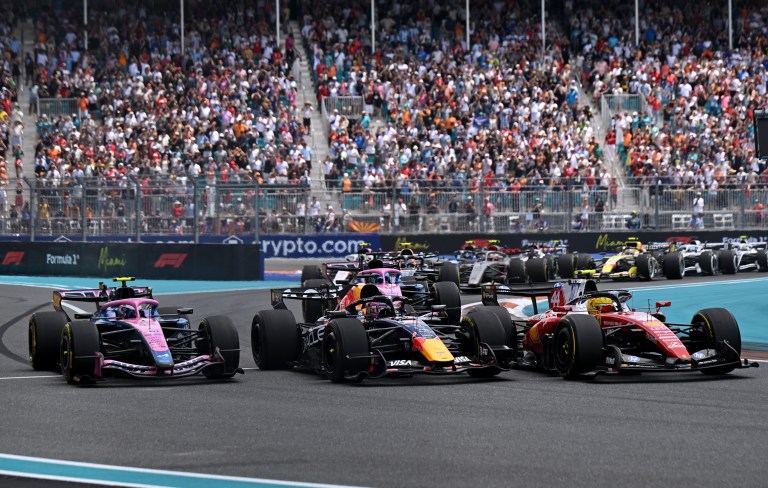
The first is safety. Oliver Bearman’s crash at Suzuka, triggered by a 50 km/h speed differential between his Haas in boost mode and Franco Colapinto’s Alpine in energy-saving mode, made it impossible to ignore what can happen when this new formula goes wrong. Haas team principal Ayao Komatsu was blunt: “We just cannot ignore it.” McLaren’s Andrea Stella had spent multiple races warning it was a matter of time — and that time ran out in Japan.
The second problem is qualifying. What was once the purest moment of the race weekend — drivers on the absolute limit, no conservation, no management — has become an energy administration exercise where power unit algorithms carry more influence than the drivers themselves. Charles Leclerc put it with characteristic sadness: the days of “crazy” Q3 laps are over. And the China case, where the car’s own system confused itself due to a minimal driver input error, illustrated just how deep the problem runs.
The third is visual and auditory: the speed drop at the end of straights as batteries run dry. Lando Norris captured it better than anyone: “It still hurts your soul seeing your speed dropping 56km/h down the straight.” It is not only aesthetically damaging — through onboard cameras, the effect is amplified by the engine note falling away, and the image that reaches viewers is of a car braking itself before it even reaches the corner.
The six solutions
The first is to increase the power available during super clipping — the system that allows energy recovery while the driver remains on full throttle. Currently that limit sits at 250 kW, compared to the 350 kW available through lift and coast (lifting off the throttle to harvest energy). Matching both limits would make super clipping the preferred recovery method, reducing the need for drivers to lift in the middle of straights.
The second is, counterintuitively, making the cars slower. Reducing the maximum MGU-K (the electric motor that drives the car) deployment from the current 350 kW would make available energy last longer across a straight, smoothing the speed curve. Also under evaluation is bringing forward the point at which deployment begins to ramp down — currently triggered at 340 km/h — so the battery drains more gradually.
The third is cutting the recharge limit. The current maximum in qualifying is 9 MJ per lap — already reduced to 8 MJ at Suzuka as an emergency measure. A reduction to as low as 6 MJ is under serious consideration, which would make it easier for drivers to hit the recharge ceiling without resorting to artificial energy management tactics. The cost: less energy recovered means less available to deploy, with an estimated impact of up to two seconds per lap in the most extreme scenario. A speed loss some argue is worth accepting if the result is slower cars driven to their absolute limit.
The fourth is the most radical: fully liberalising straight mode — the active aerodynamic system that reduces drag by between 25% and 40% by opening the wings. Currently its use is restricted to FIA-defined zones. The proposal is to remove those zones entirely in qualifying, mirroring what happened with DRS (the drag reduction system) in its early years when deployment was completely free. That would give teams the freedom to configure their downforce levels according to each circuit’s specific demands.
The fifth involves the internal combustion engine — but not for 2026. Increasing the power contribution of the thermal engine relative to the electric motor, currently balanced at roughly 55%-45%, would dramatically reduce battery dependency. The most direct route would be raising the fuel flow limit. However, current engines were designed around existing technical parameters, and forcing that change now risks pushing internal components beyond their design thresholds, creating reliability concerns. The measure is being shaped as a 2027 solution, giving manufacturers time to adapt.
The sixth is to simplify the rulebook. The Leclerc case in China — where his car’s own system confused itself due to a minimal driver input and burned energy in the wrong section of the lap — showed how deeply algorithmic code is now governing qualifying. Stripping out the most complex thresholds from the regulations would return control to the drivers and bring qualifying back to what it should always be: a contest between man and machine.
The April 9th meeting has a hard deadline. If agreement is reached, changes would come into force before Miami. If it is not, Formula 1 will arrive in Florida carrying the same problems it left Japan with — and with fewer excuses for not having solved them.
Thumbnail: By courtesy of Pirelli