Newsletter Subscribe
Enter your email address below and subscribe to our newsletter

Suzuka’s Friday tyre data points to a two-team fight at the front, with compound selection and degradation management already shaping the weekend’s strategic narrative.
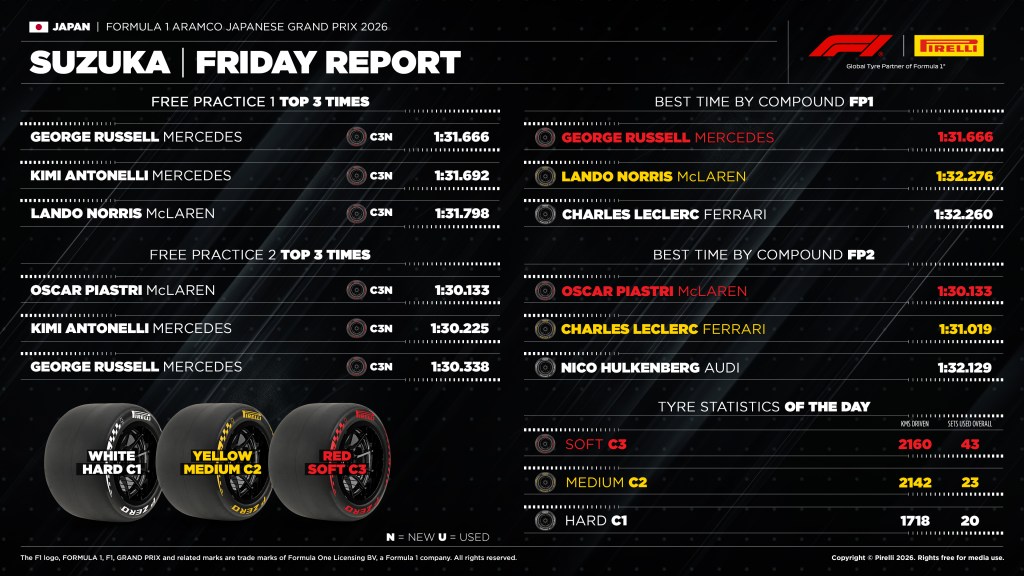
The Formula 1 Aramco Japanese Grand Prix 2026 got underway at Suzuka Circuit with two practice sessions that delivered more than just lap times. Friday’s Pirelli tyre report offered the first concrete look at how the field is handling the C1, C2, and C3 compound selection and the picture that emerges ahead of Saturday’s qualifying is one dominated by McLaren and Mercedes, with Ferrari lurking close behind.
Free Practice 1 belonged to George Russell, who clocked a 1:31.666 on the C3 Soft (the softest and fastest compound available this weekend, designed for maximum grip over a shorter window) to lead a Mercedes one-two, with teammate Kimi Antonelli just 0.026 seconds adrift at 1:31.692. Lando Norris completed the top three for McLaren at 1:31.798, all three drivers operating on new soft rubber.
The session’s best-time-by-compound breakdown told a similar story: Russell led on the Soft, while Norris posted 1:32.276 and Charles Leclerc 1:32.260, the Ferrari driver actually splitting the two top-three finishers on compound-adjusted pace, a detail that shouldn’t be overlooked going into qualifying trim.
Free Practice 2 shifted the balance. Oscar Piastri moved to the top of the timesheet with a 1:30.133, more than a second faster than FP1’s benchmark, again on the C3 Soft, underlining McLaren’s capability across both short and long runs at Suzuka. Antonelli held firm in second at 1:30.225, with Russell completing the top three at 1:30.338 as Mercedes demonstrated remarkable consistency across both sessions. Notably, Leclerc returned a 1:31.019 to lead the FP2 compound leaderboard alongside Piastri, reinforcing Ferrari’s quiet presence in the data.
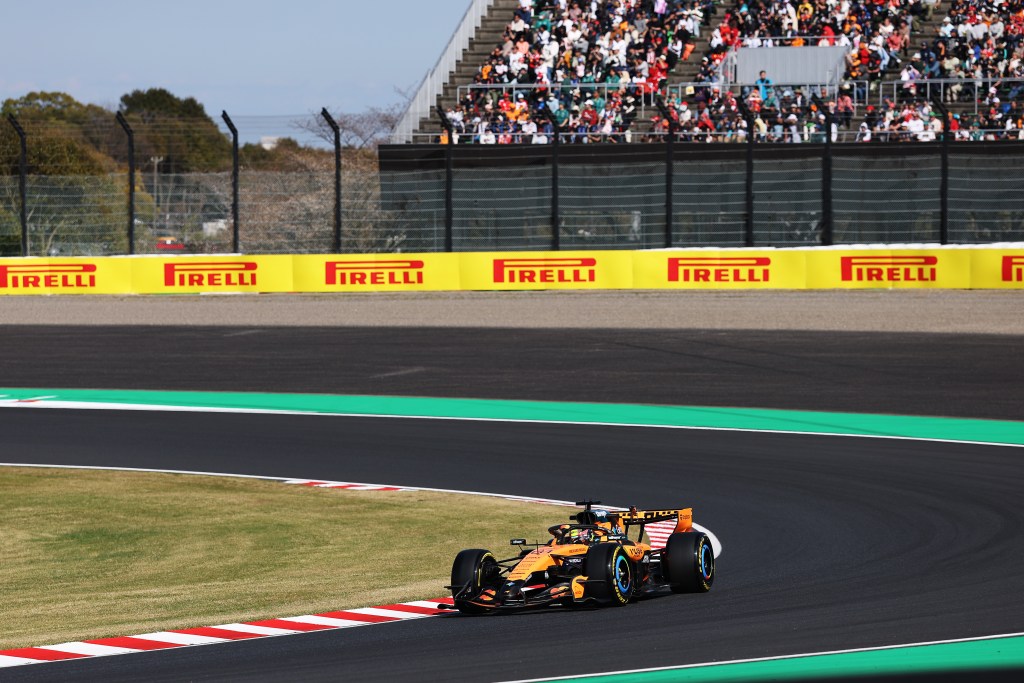
Nico Hülkenberg also featured in the compound breakdown, posting a 1:32.129 for Audi in FP2, a result that warrants attention given Suzuka’s technical and high-downforce demands.
On the tyre usage side, the Soft C3 was the compound of choice across the field, accumulating 2,160 kilometres driven and 43 sets used, the highest volume of any compound on the day. The Medium C2 followed with 2,142 km and 23 sets, while the Hard C1 saw the lightest usage at 1,718 km across 20 sets. All fastest times in both sessions were set on new C3 rubber, confirming the Soft’s dominance on Suzuka’s demanding layout.
The Pirelli tyre data heading into qualifying is unambiguous: the C3 Soft will define Q3. The gap between the top performers on that compound is measured in hundredths, meaning tyre preparation (the process of bringing tyres to their optimal operating temperature window before the flying lap) and the ability to extract peak grip on a single push lap will separate pole position from the second row.
McLaren’s Piastri is the Friday benchmark. Mercedes has shown the depth to challenge across both drivers. Ferrari’s Leclerc is close enough to make the front row a genuine three-way conversation. Saturday at Suzuka will be defined not just by power and aerodynamic efficiency but by who manages their rubber best when it counts most.
Japanese Grand Prix qualifying begins Saturday. The tires are already talking.
Thumbnail: By courtesy of Pirelli