Newsletter Subscribe
Enter your email address below and subscribe to our newsletter

Aston Martin has not scored a point in 2026. The partnership that was meant to signal a new era is now fighting to prove it can function. Miami is where that fight begins in earnest.
Honda has brought hardware modifications to the Miami Grand Prix with the specific aim of addressing the vibration problems that have undermined Aston Martin’s entire opening to the 2026 Formula 1 season. The Japanese manufacturer is calling them “countermeasures,” and the confidence with which it is presenting them suggests this is not a precautionary measure but a targeted fix built on concrete data.
The story of Aston Martin’s season so far is one of a partnership struggling under a problem that goes deeper than setup or strategy. Since the opening round in Melbourne, excessive vibrations originating from the power unit (the complete engine and hybrid system assembly supplied by Honda under a new long-term partnership) have caused serious discomfort for both Fernando Alonso and Lance Stroll inside the cockpit, restricting their mileage in multiple events. Alonso was forced to retire in China. It was not until Japan, three races into the season, that any Aston Martin driver completed a full race distance.
The five-week break created by the cancellations of the Saudi Arabia and Bahrain rounds gave Honda an opportunity it used to maximum effect. One of the AMR26 race cars was transported to Honda’s Sakura facility in Japan, where engineers conducted extensive dyno bench testing (static testing on a controlled rig that simulates the stresses a car experiences on track, allowing precise measurement without needing to run at a circuit). With a full complement of sensors attached to the car, the Honda Racing Corporation team was able to isolate the vibration sources in a way that trackside running had not permitted.
Honda’s trackside general manager Shintaro Orihara confirmed the outcome in Miami. “We gathered all the knowledge of HRC engineers and then we found some good progress on the vibration. Then we introduced the countermeasure into this event. We found good progress on vibration on the engine’s battery side and also we can see some good progress on vibration for the driver.”
He confirmed the changes are hardware related and expressed clear confidence in what the team has brought to the circuit, though he declined to detail the specific nature of the modifications.
Aston Martin’s chief trackside officer Mike Krack reinforced the message from the chassis side, where the team has also been working through its own set of improvements. One area of concern that has been confirmed is the weight of the AMR26, understood to be at least 10 kilograms over the regulated minimum of 768kg, a significant handicap in a season where the weight reduction from the previous limit of 800kg has already proven difficult for most of the grid to achieve.
“There will be changes on the car,” Krack said. “We have worked on several items. Mainly reliability, but then also car weight, driveability was one big aspect and then in terms of external changes, they will come race by race.”
He was measured about expectations, acknowledging both the scale of the progress made and the distance still to travel. “I cannot expect miracles coming to Miami, and this is the case. We are improving step by step, both reliability and performance, but we must not forget that the same applies to our competitors.”
The qualifying deficit facing Aston Martin currently stands at approximately two seconds per lap. That is not a gap closed in a single weekend. But Miami, with Honda’s hardware changes on the car and a team that has now had five weeks to address its most acute problems, represents the clearest opportunity yet for this partnership to begin showing what it actually looks like when it is working.
The relationship between Honda and Aston Martin was built on ambition. Miami is where it starts making good on it.
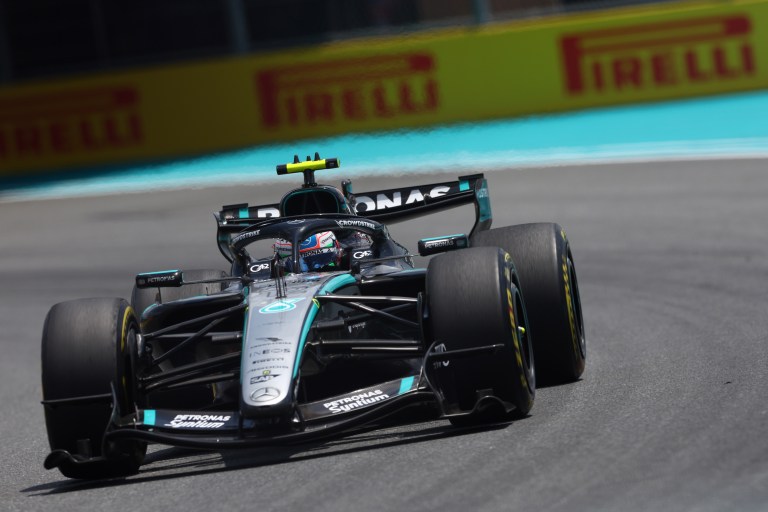
Thumbnail: By courtesy of Pirelli