Newsletter Subscribe
Enter your email address below and subscribe to our newsletter
Using Machine Learining and official F1 telemetry, we ran the numbers on the 2025 Abu Dhabi Grand Prix before the lights went out.
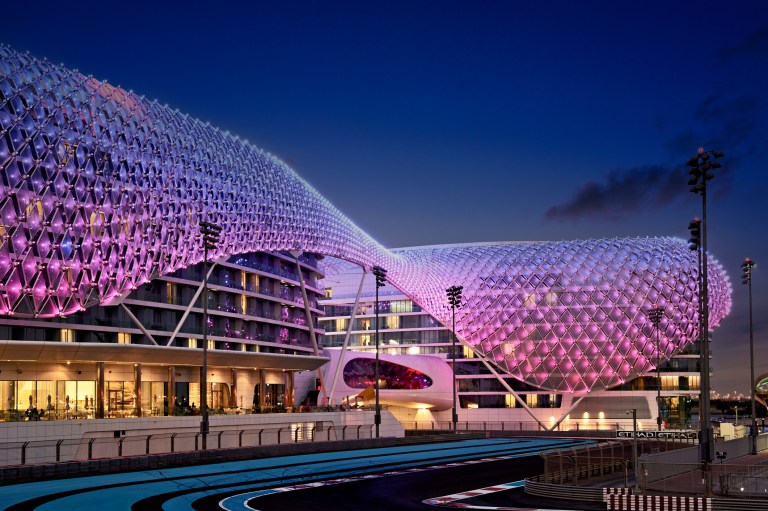
The final race of the 2025 Formula 1 season. Yas Marina. The circuit where champions are crowned and seasons are settled. We fed real telemetry data into a machine learning model and asked it one question: who wins?
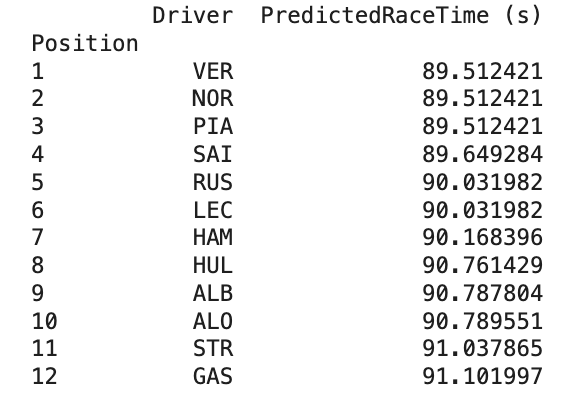
P1: Max Verstappen — Red Bull
P2: Lando Norris — McLaren
P3: Oscar Piastri — McLaren
The model hands the season finale to Verstappen. At Yas Marina, where qualifying is decisive and Verstappen’s pole position pace translates directly into race dominance, the data backs the four-time world champion to sign off the season with a win. McLaren fill out the podium, Norris and Piastri both predicted within fractions of a second of Verstappen, reflecting just how tight the battle between Red Bull and McLaren has been all year.
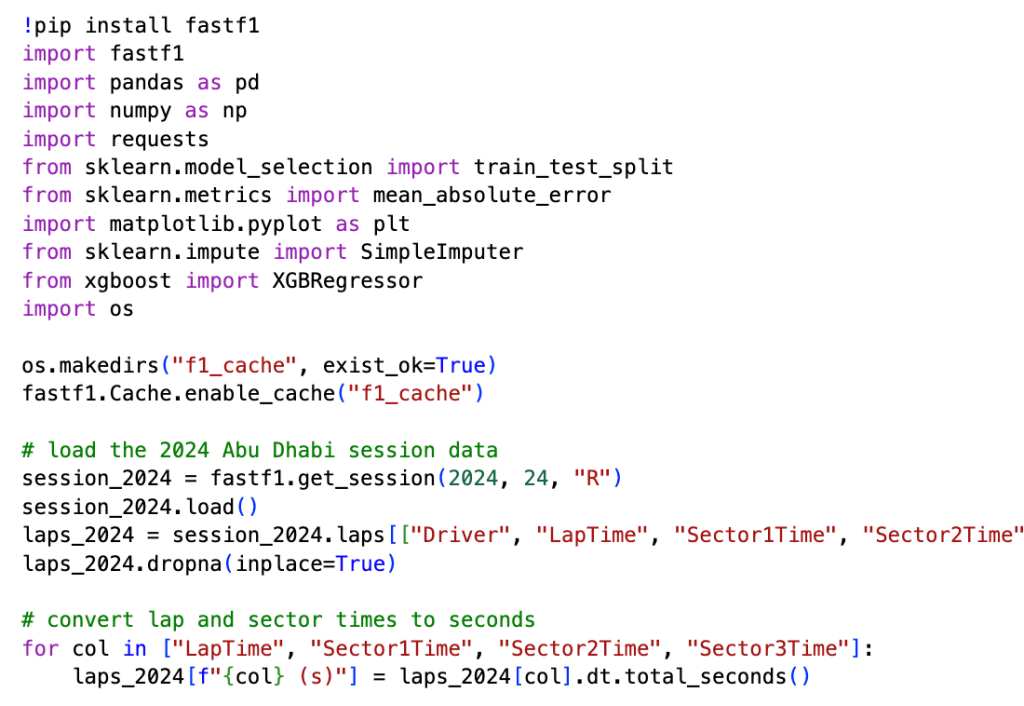
The model is built on FastF1, an open-source Python library licensed under the MIT License that provides access to the official Formula 1 timing feed, the same data the teams use at the circuit. From the 2024 Abu Dhabi Grand Prix at Yas Marina, we load every lap driven by every driver and build a circuit-specific picture of who performs at this track.
Two automatic cleaning steps ensure the data is meaningful. A track status filter keeps only green flag laps; safety car and yellow flag periods are discarded since those artificially slow times would distort the model’s understanding of true race pace. An outlier filter then removes in-laps and out-laps using each driver’s own statistical range, leaving only clean, representative race laps.
Qualifying Time is the dominant factor at Yas Marina, and the model’s feature importance chart confirms this decisively. The Yas Marina circuit has limited overtaking opportunities despite its long straights, meaning the driver who qualifies on pole controls the race. Verstappen’s 82.207s pole lap is the fastest of the field by a meaningful margin, and the model weights this heavily.
Clean Air Race Pace measures each driver’s speed when running freely in clear air. Calculated from 2025 season race stint data, it captures the underlying performance of each car and driver combination stripped of traffic effects.
Team Performance Score reflects constructor championship standings; encoding the gap in machinery between McLaren at the top and the rest of the field. With McLaren on 800 points and Red Bull on 426, the model recognizes that Verstappen is extracting exceptional results from a car that is no longer the fastest on the grid.
Rain Probability and Temperature are pulled live from the OpenWeatherMap API for race day at Yas Marina. Abu Dhabi in December is reliably warm and dry, both factors carry near-zero importance in this prediction.
Sector Times from Abu Dhabi 2024 add circuit-specific nuance, capturing each driver’s historical strengths across Yas Marina’s three very different sectors.
The five inputs feed into XGBoost (Extreme Gradient Boosting) a machine learning algorithm used across finance, medicine, and sports analytics worldwide. It learns the relationship between driver characteristics and race pace from historical data, then applies those patterns to predict the 2025 outcome.
Monotone constraints enforce physical logic throughout, a better qualifying time must always produce a better predicted result, and stronger team performance must always help. The model’s prediction error, validated on held-out data, came in at 0.99 seconds; the tightest margin we have seen across our race prediction series, reflecting how consistent the Yas Marina circuit is year on year.

The feature importance chart tells the Abu Dhabi story clearly: qualifying time towers above every other input. At this circuit more than almost any other on the calendar, Saturday defines Sunday.
The model separates the field into three distinct groups. Verstappen, Norris and Piastri share identical predicted times at the front — the margin between them is effectively zero, meaning any of the three could realistically take the win. Sainz in fourth is the surprise, the model identifying Williams as stronger here than their constructor standing suggests. Russell and Leclerc follow closely, with Hamilton seventh as he continues his adaptation to the Ferrari.
The midfield compresses tightly from Hulkenberg through to Alonso, all within half a second of each other — exactly the kind of close racing Yas Marina typically delivers in the lower half of the top ten.
Race data sourced via FastF1 by Tobias Oehrly, licensed under the MIT License. Prediction model built in Python using XGBoost and scikit-learn. Copyright notice: Permission is hereby granted, free of charge, to any person obtaining a copy of this software, to deal in the Software without restriction, including the rights to use, copy, modify, merge, publish, and distribute, subject to the condition that the above copyright notice and this permission notice are included in all copies or substantial portions of the Software.