Newsletter Subscribe
Enter your email address below and subscribe to our newsletter

Some races announce themselves loudly. Others are quieter in execution but equally ruthless in what they reveal. The 2026 Chinese Grand Prix belongs to the second category. The position chart for Shanghai does not offer the dramatic crossing of lines that Melbourne did. What it offers instead is something more considered, and in its own way more striking: a single flat line at the top of the graph that never moves, and a grid-full of stories playing out beneath it.
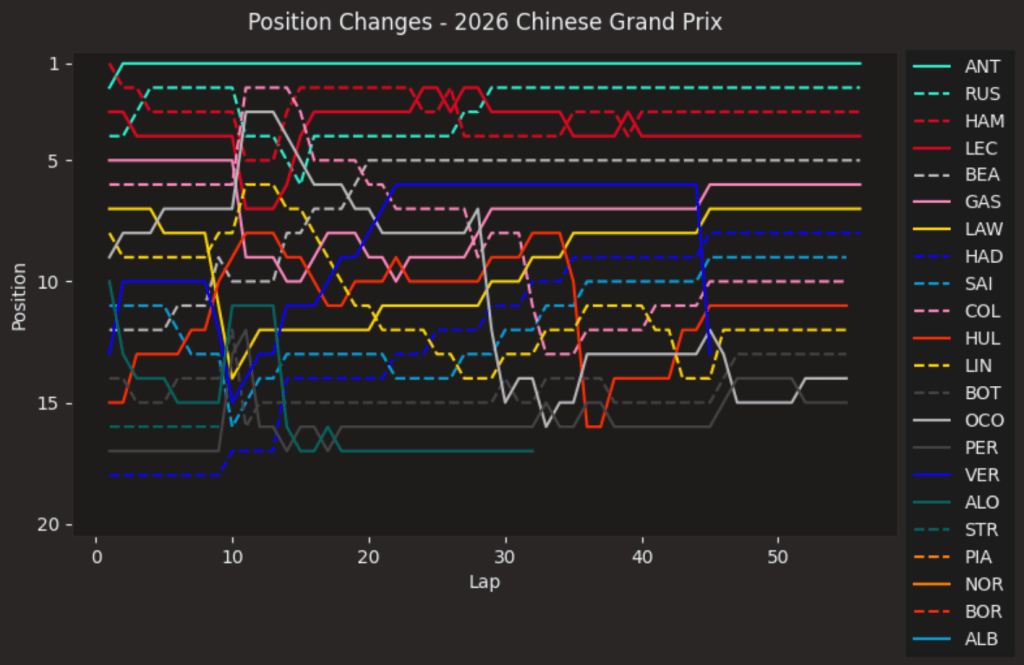
The defining visual of this race is the cyan trace belonging to Kimi Antonelli. It begins at P1, holds at P1 through the opening lap chaos, survives the only Safety Car of the afternoon, and arrives at the finish still at P1 across 56 laps. It does not dip. It does not waver in any meaningful way. For a 19-year-old collecting his maiden Grand Prix victory, the line on the chart has the composure of a much older race.
The only moment it could have bent was at the start. Lewis Hamilton, launching from P3, got the jump on both Silver Arrows through the opening sequence and briefly held the lead. On the chart, his dashed red line crosses above Antonelli’s for a matter of corners. But Antonelli re-takes the position before the end of Lap 2, and from that point the cyan line simply settles. The Safety Car, triggered by early-race contact in the midfield, compresses the entire field behind the Mercedes. When racing resumes, Antonelli extends without drama. “I’m speechless. I’m about to cry, to be honest,” he said afterwards. The chart gives no hint of those emotions. It registers only control.
If Antonelli’s line is the story above the noise, the story inside the noise belongs to the two Ferraris. Hamilton’s dashed red trace and Leclerc’s solid red line spend the bulk of the race between P3 and P4, but the interval between them is anything but settled. They trade the position repeatedly. Around Lap 35, the lines cross as Leclerc runs deep at Turn 14, handing Hamilton P3. They cross again on Lap 39 as Leclerc fights back at the same hairpin. Then again, definitively, as Hamilton makes a decisive move at Turn 1 that the chart records as the two lines separating and refusing to converge again.
It is a subplot the position chart almost undersells. The visual distance between the two red traces is never large enough to suggest comfort. Hamilton holds P3 at the flag, collecting his first Grand Prix podium for Ferrari in his 26th attempt with the Scuderia. The chart captures the arithmetic of that outcome. The weight of it is harder to graph.
The most unusual feature of this position chart is what is missing from it. Lando Norris, Oscar Piastri, Gabriel Bortoleto, and Alexander Albon all failed to start the race. On a chart plotting 56 laps of action, their lines do not appear at all. Four drivers, four cars, zero traces.
For McLaren, the absence is historic in the worst sense. Their double non-start was the first time both McLarens failed to begin a race since the 2005 United States Grand Prix , when 14 cars on Michelin tyres withdrew over safety concerns. That was a collective protest. This was a mechanical failure, power unit issues on both cars discovered before the formation lap. The papaya lines are not cut short mid-race. They simply do not exist. In a chart full of movement and competition, four blank spaces in the legend tell their own complete story.
If Antonelli’s line is the race’s cleanest narrative, Isack Hadjar’s is its most physically dramatic. The Red Bull rookie, who spun through Turn 13 on the opening lap after contact, drops immediately to the bottom of the chart. From that position, buried in the pack behind drivers who had done nothing wrong, his dashed blue line begins climbing.
By the closing stages it has worked its way into the top ten. It finishes at P8, a result that the position chart makes look almost inevitable once the trajectory is established, even though the lap count required to get there was anything but routine. The chart does not reward or penalise drivers for how they arrived at their starting point. It only records where they went from there.
Max Verstappen’s solid blue trace tells a shorter story in Shanghai than it did in Melbourne. He is present in the opening phase, running in the points, his line moving through the field in the manner now familiar from a driver who rarely accepts static positioning. Then, in the latter portion of the race, it stops. A retirement, his second in two rounds, leaves a clean break where his line should have continued. Verstappen was one of three drivers forced to retire from this year’s Chinese GP as he continues to struggle with his new Red Bull machinery.
In Melbourne, his line told a story of 14 positions gained. In Shanghai, it tells a story of potential erased before it could be counted. The two charts together are beginning to sketch something about the early shape of this season: Red Bull has pace but not reliability, and the position chart, patient and precise, is keeping the record.
Shanghai produced a landmark result, a 19-year-old Italian winning a Grand Prix for the first time since Fisichella in 2006, and it did so on a chart that was unusually calm at the front. But beneath Antonelli’s flat cyan line, the race was full of consequence: a Ferrari internal duel that went down to the final handful of laps, a McLaren catastrophe rendered as pure absence, a rookie climb from the back, and a championship contender’s afternoon ending ahead of schedule. The position chart captured all of it. Fifty-six laps. Twenty cars on the entry. Sixteen that made the start. One that never needed to look over its shoulder.
Thumbnail credits: © Filedimage | Dreamstime.com